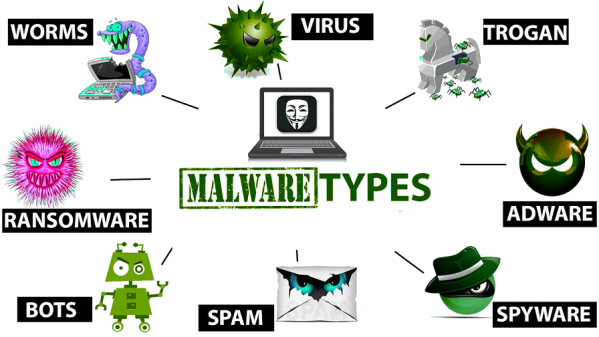
Malware (malicious software), is an umbrella term used to refer to a variety of forms of suspicious or untimely software. Cyber-criminals design malware to settle computer functions, steal data, bypass access controls, and unless cause infliction to the host computer, its applications or data.
Most Common 5 Malware
- Adware
- Malvertising
- Spyware
- Ransomware
- Trojans
Adware
The adware attempts to expose the settled end-user to unwanted, probably malicious advertising. A common adware program might redirect a user’s browser searches to look-alike web pages that contain other product promotions.
Malvertising
The malvertising is the use of authentic ads or ad networks to covertly deliver malware to unsuspecting users’ computers. For example, a cyber-criminal might pay to set an ad on a legitimate website. When a user clicks on the ad, code in the ad either redirect them to a malicious website or installs malware on their computer. In some cases, the malware embedded in an ad might perform automatically without any action from the user, a method referred to as a “drive-by download.”
Cyber-criminals have also been known to settle genuine ad networks that deliver ads to many websites. That’s often how popular websites such as the New York Times, Spotify and the London Stock Exchange have been vectors for malicious ads, putting their users in danger.
The goal of cyber-criminals who use malvertising is to earn money, of course. Malvertising can pass any type of money-making malware, including ransomware, crypto-mining scripts or banking Trojans.
Spyware
Spyware is most often practiced by people who want to check on the computer activities of loved ones. Of course, in targeted attacks, criminals can use spyware to log the keystrokes of victims and get access to passwords or intellectual property.
Adware and spyware programs are usually the simplest to remove, often because they aren’t nearly as bad in their intentions as other types of malware. Find the malicious executable and block it from being executed — you’re done.
A much bigger interest than the actual adware or spyware is the device is used to exploit the computer or user, be it social engineering, unpatched software, or a dozen other root exploit causes. This is because although a spyware or adware program’s purposes are not as malicious, as say, a backdoor remote access Trojan, they both use the same methods to break in. The appearance of an adware/spyware program should serve as a warning that the device or user has some sort of weakness that needs to be fixed before real harm happens. Complete Security Software can offer better protection to prevent deadly spyware.
Ransomware
Malware applications that encrypt your data and hold it as hostage waiting for a cryptocurrency pay off has been a huge percentage of the malware for the last few years, and the percentage is still increasing. Ransomware has often crippled companies, hospitals, police departments, and even entire cities.
Most ransomware programs are Trojans, which means they must be circulated through social engineering of some sort. Once performed, most look for and encrypt users’ files within a few minutes, although a few are now taking a “wait-and-see” approach. By watching the user for a few hours before setting off the encryption routine, the malware admin can figure out exactly how much ransom the victim can produce and also be sure to delete or encrypt other supposedly safe backups.
Ransomware can be prevented just like every other type of malware program, but once done, it can be hard to reverse the damage without a good, validated backup. According to some studies, about a quarter of the victims pay the ransom, and of those, about 30 per cent still do not get their files opened. Either way, unlocking the encrypted files, if even possible, takes particular tools, decryption keys and more than a bit of success. The best advice is to make sure you have a good, offline backup of all important files.
Trojans
Computer worms have been renewed by Trojan horse malware programs as the weaponry of choice for hackers. Trojans disguise as legitimate programs, but they include malicious instructions. They’ve been around forever, even longer than computer viruses, but have taken hold of current computers more than any other type of malware.
A Trojan must be effected by its victim to do its work. Trojans usually arrive via email or are forced on users when they visit infected websites. The most popular Trojan type is the fake antivirus program, which pops up and claims you’re infected, then instructs you to run an application to clean your PC. Users take the lure and the Trojan takes source.
Trojans are hard to defend against for two reasons: They’re easy to write and develop by tricking end-users — which a patch, firewall, and other traditional defenses cannot block. Malware writers pump out Trojans by the millions each month.

 Techno Boost